Cory Doctorow is a man from Canada who is interested in writing. He is a blogger, journalist and writer (science fiction). He is the one who believes that copyright laws should be liberalized - to allow free sharing of all digital media.
I was quite surprised when I noticed that he has been dropped out from 4 universities without attaining any degree. Was he the bird with passage or he just didn't feel that these were the right programs to him .. ?
But he have had more time to do what he liked - writing. Fascinating is that at the same time he published his books ('Down and Out in the Magic Kingdom', 'A Place So Foreign and Eight More',..) in printed version he released electronic version. The only principle was that users were able to circulate the edition as long as they neither made money from it nor used it to create derived works.
I think it was useful in its own way. There are people who like to read books from paper and there are people who doesn't mind reading it from the computer.
If a writer will release his(her work in both - digital media and on paper - then there is also twice as much chance to get more familiar to people. Which leads to the fact that if one books is good, people will definately be ready to buy next book that comes out. They know what they will get.
So I think that he is smart in its own way by doing so.
Thursday, March 25, 2010

The review of blue team's version
So, I start with testing another team game. As I have already heard that there have been some problems to get files working, I know what to do. I corrected their _main.cfg file by replacing ’data/campaigns/The_Cafeteria’ with ’ data/add-ons/The_Cafeteria’ and ’@campaigns’ with ’~add-ons’.
I am using version 1.6.5 to test it.
The cafeteria is a campaign about the economical fight. Who has better things to offer and more clients and more Money!

I started and chose 'Normal' version of the game:

And I get error: ’Tundmatu stsenaarium: ’01_scenarion’.
It seems that the game is not working in version 1.6.5. I asked others how could I get the game to work. They said that it is working with version 1.7. I tried with it, but the error message was the same.
So I tried again with 1.6.5 - I uninstalled it and then installed it again. It seems that I am able to play it, as now I even see the pictures they have added to their campaign, but after choosing the level I received:

As I have heard that some people managed to play few levels of the game, then maybe there is something wrong in my computer settings, cause source code is same for everybody.
So I started to surf in their catalogue to find maps and pictures and code files.
I have to say I liked the background map idea - like Estonia, and instead of water there is a cafeteria table with cups and cigarettes. Nice idea.
Characters seem to be nicely picked as well - tough (like mafia people).
I am sure that they have seen a lot of effort in creating this campaign, but I am just not able to play it by myself.
I am using version 1.6.5 to test it.
The cafeteria is a campaign about the economical fight. Who has better things to offer and more clients and more Money!

I started and chose 'Normal' version of the game:
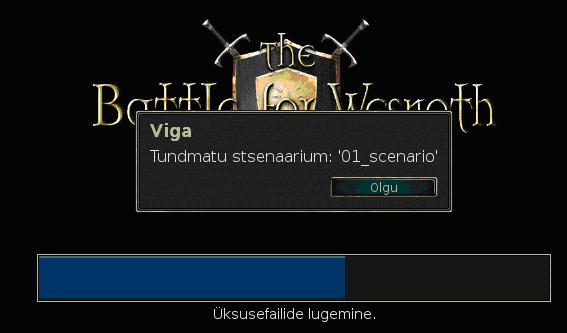
And I get error: ’Tundmatu stsenaarium: ’01_scenarion’.
It seems that the game is not working in version 1.6.5. I asked others how could I get the game to work. They said that it is working with version 1.7. I tried with it, but the error message was the same.
So I tried again with 1.6.5 - I uninstalled it and then installed it again. It seems that I am able to play it, as now I even see the pictures they have added to their campaign, but after choosing the level I received:

As I have heard that some people managed to play few levels of the game, then maybe there is something wrong in my computer settings, cause source code is same for everybody.
So I started to surf in their catalogue to find maps and pictures and code files.
I have to say I liked the background map idea - like Estonia, and instead of water there is a cafeteria table with cups and cigarettes. Nice idea.
Characters seem to be nicely picked as well - tough (like mafia people).
I am sure that they have seen a lot of effort in creating this campaign, but I am just not able to play it by myself.
Wednesday, March 24, 2010
Copyleft
We are living in the world where everything has its price and everything has its rights. What can be done with one thing, can't be done with another. To restrict the rights of services or products or etc.. society uses laws and restrictions - one of them is Copyright. Copyright is a set of rights which are granted to the author or creator of an original work. It includes the right to copy, distribute and adapt, so the author has full control over his/her work. For example intellectual property, patents, trademarks..
The opposite of copyright is copyleft which is also known as ShareAlike in creative commons. It sounds like game with words and it is.
Copyleft's goal is to use copyright to remove the rights of piece of work that come by default from the law. To remove the restrictions to copy, distribute or adapt it. But it has its catch - the same rights has to have the work which source has copyleft rights which means that all derived works must be distributed under the same terms as the original work.
It can be said that copyright can be strong, weak or neither of them.
Weak copyleft licenses are used to create for example software libraries, like Mozilla Public License. Weak means that only some of the derivative work needs to be distributed under a copyleft license.
Strong copyleft forbids linking the subject work into larger works or projects that are not licensed with a compatible copyleft terms. For example GPL.
The opposite of copyright is copyleft which is also known as ShareAlike in creative commons. It sounds like game with words and it is.
Copyleft's goal is to use copyright to remove the rights of piece of work that come by default from the law. To remove the restrictions to copy, distribute or adapt it. But it has its catch - the same rights has to have the work which source has copyleft rights which means that all derived works must be distributed under the same terms as the original work.
It can be said that copyright can be strong, weak or neither of them.
Weak copyleft licenses are used to create for example software libraries, like Mozilla Public License. Weak means that only some of the derivative work needs to be distributed under a copyleft license.
Strong copyleft forbids linking the subject work into larger works or projects that are not licensed with a compatible copyleft terms. For example GPL.
Monday, February 1, 2010
Review of 'Battle of Wesnoth'
Battle for Wesnoth is a freely available strategy came which is based on fantasy. It is a game for one player or multiple players who have to fight against the 'bad guys' to reclaim the throne of Wesnoth. All these fights will direct the player into new adventures where one can win only with good strategy.
Player has also opportunity to create armies and send them 'elsewhere' to protect oneself.
Possible figures in the game: humans, elves, dwarves, orcs, trolls. There might be more because everybody can customize the game. As I have just started to play it, I haven't seen them all yet.
I like the background music - it adds extra value to the game and makes it more dramatic.
It was very easy and simple to download it as all the necessary files were packed into one.
After I have played more, I can say more. :)
Player has also opportunity to create armies and send them 'elsewhere' to protect oneself.
Possible figures in the game: humans, elves, dwarves, orcs, trolls. There might be more because everybody can customize the game. As I have just started to play it, I haven't seen them all yet.
I like the background music - it adds extra value to the game and makes it more dramatic.
It was very easy and simple to download it as all the necessary files were packed into one.
After I have played more, I can say more. :)
FSF vs OSI
The Open Source Initiative (OSI) is a non-profit corporation which is formed to educate the benefits of open source and connect different constituencies in the open-source community.
The Free Software Foundation (FSF) is a non-profit corporation to support the free software movement and to promote the universal freedom to create, distribute and modify computer software.
The comparison of FSF and OSI
The term 'Open source' was created in 1998 and since then its the part of 'Free software' definition. According to this almost all the open source programs are also free software, but there are exceptions.
Free software refers to freedom not price, while open source refers to it as well but with some certain restrictive licenses, which are not acceptable to free software movement (according to Stallman).
Open source is a development methodology, but free software is a social movement.
Free software expresses the view of life. User has following possible rights:
- right to run the program
- to investigate how the program works and adapt it according to one needs.
- right to forward the copy to someone else
- right to change or fix the program and spread it.
Free software is focused to general welfare.
Open Source software is more or less the same, but not exactly the same class of software! Differences are small: nearly all software is open source and nearly all open source software is free.
The distribution terms of open-source software must comply with the following criteria:
- free redistribution
- the program must include source code
- the license must allow modifications and derived works, and must allow them to be distributed under the same terms as the license of the original software.
- integrity of The Author's Source Code
- the license must not discriminate against any person or group of persons or fields of endeavor
- license must not be specific to product
- license must not restrict other software
- license must me technology-neutral.
The Free Software Foundation (FSF) is a non-profit corporation to support the free software movement and to promote the universal freedom to create, distribute and modify computer software.
The comparison of FSF and OSI
The term 'Open source' was created in 1998 and since then its the part of 'Free software' definition. According to this almost all the open source programs are also free software, but there are exceptions.
Free software refers to freedom not price, while open source refers to it as well but with some certain restrictive licenses, which are not acceptable to free software movement (according to Stallman).
Open source is a development methodology, but free software is a social movement.
Free software expresses the view of life. User has following possible rights:
- right to run the program
- to investigate how the program works and adapt it according to one needs.
- right to forward the copy to someone else
- right to change or fix the program and spread it.
Free software is focused to general welfare.
Open Source software is more or less the same, but not exactly the same class of software! Differences are small: nearly all software is open source and nearly all open source software is free.
The distribution terms of open-source software must comply with the following criteria:
- free redistribution
- the program must include source code
- the license must allow modifications and derived works, and must allow them to be distributed under the same terms as the license of the original software.
- integrity of The Author's Source Code
- the license must not discriminate against any person or group of persons or fields of endeavor
- license must not be specific to product
- license must not restrict other software
- license must me technology-neutral.
Thursday, October 1, 2009
Wednesday, September 30, 2009
Monday, December 8, 2008
The illustrative case of hacktivism
Hacktivism is the nonviolent use of illegal or legally ambiguous digital tools in pursuit of political ends.
Lets say that there is a group of people who find nuclear weapons very unsympathetic and who have bigger knowledges about computers and digital world than general user. Lets say they discover that some countries are making some tests to improve the power of the nuclear weapon and they start to fight for it. They are hacking into the system and deleting some data or start to use emails which contain information hackers like. They add some content into organization website and according to this they may ruin some relations.
For example: Three teenagers broke into computer systems at India's Bhabha Atomic Research center in Bombay for a reason to protest against two nations recent series of nuclear weapons tests. They deleted some data, send emails and changed web page.
Lets say that there is a group of people who find nuclear weapons very unsympathetic and who have bigger knowledges about computers and digital world than general user. Lets say they discover that some countries are making some tests to improve the power of the nuclear weapon and they start to fight for it. They are hacking into the system and deleting some data or start to use emails which contain information hackers like. They add some content into organization website and according to this they may ruin some relations.
For example: Three teenagers broke into computer systems at India's Bhabha Atomic Research center in Bombay for a reason to protest against two nations recent series of nuclear weapons tests. They deleted some data, send emails and changed web page.
CHapter 18 - The business of science
Our lives are moving more and more into the Internet: chatting with friends, keeping diaries (blogs), learning (e-learning), watching videos, listening music, doing business and also making science. Countries who are using and owning better technical equipment in any arbitrary area have advantages over the people who have less.
Let's say that scientists discover some sort of new technique how to cure specific cancer and they invent special tool for it which also assume that you have some other parts before you can start using new invention. IF poorer countries/areas/hospitals can't afford these expected parts, then they do not have the opportunity to help people.
There are systems in the hospitals, where are listed illnesses one person have had in one database. Whoever doctor one is visiting, then the data is always accessible. But if poorer countries/areas/hospitals can't afford the databases and everything that comes with it (management, service providers.. ) then again the quality (in this case the doctor's awareness of illnesses) is not so good.
Let's say that scientists discover some sort of new technique how to cure specific cancer and they invent special tool for it which also assume that you have some other parts before you can start using new invention. IF poorer countries/areas/hospitals can't afford these expected parts, then they do not have the opportunity to help people.
There are systems in the hospitals, where are listed illnesses one person have had in one database. Whoever doctor one is visiting, then the data is always accessible. But if poorer countries/areas/hospitals can't afford the databases and everything that comes with it (management, service providers.. ) then again the quality (in this case the doctor's awareness of illnesses) is not so good.
Link portfolio for ethics and law
Ethics in Turbulent Times
Rid the fools of their money: the online world of crime and fraud
Social networking, social engineering
- Four videos about Global Dignity. It is an an autonomous non-profit, non-criticism and non-partisan initiative, which mission is to implement every human being's universal right. (Global Digniy Co-Founders, Crown Prince Haakon, John Hope Bryant, Professor Pekka Himanen)
- Handy's iterview
- Towards the Information Society in the Central and Eastern European Countries: Twentyseven ideas for European initiatives - It was written 2001 and there can be seen how Europe tried to go towards the information society.
- Yochai Benkler is giving an interview - The download of the invisible hand broadcast which talks about management and strategy
- What is cyberspace?
- "The Many Forms of Internet Censorship" by Tino Bruno
- "PPC Censorship Propaganda and Free Speech" by Brian Hack
Rid the fools of their money: the online world of crime and fraud
- This article is written by David MacGregor: Scams, Gambling & Investments: How to spot the difference? This article is talking about some scam schemes and also some tips how to recognize the difference between the real thing and fraud.
- Tips how to find the honest broker while trading.
- This article is talking about one online fraud parts: phishing.
- This article is talking about digital divide and the fact that it contains tree main stages: economic divide, usability divide and empowerment divide.
- In January the Inderscience's International Journal of Knowledge and Learning published new report about digital divide. And according to this sub-Saharan Africa will miss technical opportunities if the digital divide between developed world and Africa is not closed soon.
- Doris Lessing: “How are we, our minds, going to change with the new internet, which has seduced a whole generation into its inanities so that even quite reasonable people will confess that once they are hooked, it is hard to cut free, and they may find a whole day has passed in blogging and blugging etc.”
- There is a video about ubiquitous computing. It defines it and makes some good examples and explanations: For example in year 2017 you are unconscious and leading to the hospital, nobody know who you are, but you have a cheap which tells all the necessary information..
- Google is building an ubiquitous web.
- Ubiquitous computing: An interesting new paradigm by Marcia Riley
- This wikipage was created during one school project and I find it good for the introduction.
- This aricle is written by Nicholas Tan: Computer Security Ethics and Privacy. Article is talking about ethical and privacy matters with specific examples.
- Hear the lecture by Dr Genevieve Bell who is an anthropologist and ethnographer with an academic and industry background. She is talking about future of digital world and digital lives.
Social networking, social engineering
- What is social engineering ? It gives a short review about social engineering.
- Social Engineering Fundamentals, Part I: Hacker Tactics by Sarah Granger
- Description of copyright
- This article is explaining the difference between hackers and crackers and also talking about how to keep passwords safe.
- There are higher demands to the road users due to increased mobility. Their safety is endangered. Solution is the Innovative Digital Enforcement Environment, which is a system which can measure speed, both on location and over sections, and red light infringements.
- Why Free software is better than open software? Find out.
- Dual Licenses and open source: Best of both worlds?
- Homepage for the artists and creators who would like to spread their work without strict copyright laws.
- Guick and easy guide to creative commons licenses
- "The Secret of Google juice?" - see the slideshow about Google strategy and business model.
- Perfect example which shows that music can be sold via Internet: Leona Lewis song was downloaded for money approximately 69 244 units with first two days.
Saturday, December 6, 2008

Wednesday, December 3, 2008
Chapter 20 - Copying resrtictions
I think it's good that there are copy restrictions, otherwise we would end up in the world of lies. Many people would tell or write something which is not their idea, as their idea by not referencing to any source. IF sources are mentioned then everything is normal and this kind of situation also gives some credit to the source owner, has his/her work has been highly evaluated and worth to refer.
Referring and mentioning the source in the Internet also gives us more connected links. If one is looking something and clicks the referred link, one can find again some other links and in this way find the original source or many other interesting information about the same subjects.
So I think restrictions are good if there are as much and as less of them as possible. Too much restrictions is not good, too much freedom is not good as well - so there has to be the golden middle ground!
Referring and mentioning the source in the Internet also gives us more connected links. If one is looking something and clicks the referred link, one can find again some other links and in this way find the original source or many other interesting information about the same subjects.
So I think restrictions are good if there are as much and as less of them as possible. Too much restrictions is not good, too much freedom is not good as well - so there has to be the golden middle ground!
Chapter 17 - GNU GPL
I start with the title of the first part of the chapter: "Information wants to be free". This is really strong argument. As Matthew Lesko is saying in his article that information is the currency in the world today and those who owns it are the richest; What will happen if something so powerful would be totally free?
We have the Copyright law which protects the owner of an original work of authorship. We also have trademarks, patents, industrial design rights, trade secrets and etc. Contrary to this we have Copyleft which gives bigger opportunities and freedom to the users to spread and change the piece of work by removing restrictions on distributing copies and works witch are modified for others and requires the same rights to the works which are done after the original.
The first Copyleft license is called GNU GPL - General Public License and its goal is to protect the freedom of the user, not to limit it. It is developed by Richard Stallman and his colleagues in 1989 an according to this user have rights to:
If huge amount of information would free, then we would live in more developed world than we do now.
I like the idea of GPL, because it gives the freedom where all the good things can start.
We have the Copyright law which protects the owner of an original work of authorship. We also have trademarks, patents, industrial design rights, trade secrets and etc. Contrary to this we have Copyleft which gives bigger opportunities and freedom to the users to spread and change the piece of work by removing restrictions on distributing copies and works witch are modified for others and requires the same rights to the works which are done after the original.
The first Copyleft license is called GNU GPL - General Public License and its goal is to protect the freedom of the user, not to limit it. It is developed by Richard Stallman and his colleagues in 1989 an according to this user have rights to:
- use, copy and distribute the work for any purpose (including business)
- study the work - for software, demands inclusion of the source code
- modify the work and develop new works based on it
- distribute the derived works under the same conditions
If huge amount of information would free, then we would live in more developed world than we do now.
I like the idea of GPL, because it gives the freedom where all the good things can start.
Tuesday, December 2, 2008
Review of '3some' wiki page
The main page of the wiki is very clear and nice. Picture have a create effect and also say a lot about the subject, which is “Hacker Ethics in Web 2.0 and 21st Century Content development”.
The '3some' team had four members and from main page is possible to view who has done which part of the work.
The upper links in the right corner doesn't contain any links, but actually it doesn't bother much because all the needed links are provided in the left column and also before every member name in the main page.
I started with hitting the link in front page and assume that this is the introduction page. It was. From introduction page I was able to read about the influence of web 2.0 on society, hacker culture and how hacker ethics are applied. I was also able to see many variants of hackers definitions and a bit of advance information about hackers. Interesting to know that word 'hacker' was nothing to do with computers at first, and this word could be applied to anybody who had skills and motivation to go beyond of expected limits.
There is also very precisely described the essence of the hacker. There is said that a hacker is a person who enjoys exploring the details of programmable systems and like to program himself/herself; appreciates the hack value and is quick in thinking; is expert or enthusiast of any kind; enjoys intellectual challenges or is somebody who is poking around to discover sensitive information.
Hacker is the person who is called hacker by others not called by oneself. And if one claims he/she is hacker but isn't, then this will be soon discovered.
There are also mentioned some of the most famous hackers: Linus Torvalds, Dennis Richie, Ken Thompson, Stephen Wozniak and Tim Berners-Lee. Interesting to read about them.
There is also mentioned one very nice metaphor for hackerdom - gift culture. That hacker gives away the time, creativity and results of ones skills. Sweet - it sounds like Christmas time, when Santa is handing out the presents. :)
Provided also the list of things one should do to be respected by hackers. This would be very good knowledge for beginners.
Applicability of hacker ethics - it is written that hacker ethics has remained the same since MIT times, just environment have changed. And also that new hackers know traditional hacker rules, but just add some innovation for them because of changes in the society. Specially I liked: self defense and trust, but test. These were so contemporary.
When I am in the middle of reading it I suddenly realize that this introduction page is the hole work together and when clicking on the title, then I will be lead to each part separately. Very clever. :)
I am also able to read about the term web 2.0 and its history. It is mentioned that web 2.0 key feature is the development of software which allows mass participation in social activities like sharing pictures , video or information or just networking, bookmarking or tagging. There is also the list of popular web 2.0 websites.
In conclusion they are saying that: "Ideally Hacker Ethics will be better understood, perhaps even the term 'Hacker' can lose it's negative connotation in the future - and be less misunderstood."
The list of references is quite long and includes some of the names we have gone through in this course.
Also I like the forum idea. Discussions are always available to everybody and very easy to communicate.
This team managed to do their work well and would evaluate them with expression: very good.
The '3some' team had four members and from main page is possible to view who has done which part of the work.
The upper links in the right corner doesn't contain any links, but actually it doesn't bother much because all the needed links are provided in the left column and also before every member name in the main page.
I started with hitting the link in front page and assume that this is the introduction page. It was. From introduction page I was able to read about the influence of web 2.0 on society, hacker culture and how hacker ethics are applied. I was also able to see many variants of hackers definitions and a bit of advance information about hackers. Interesting to know that word 'hacker' was nothing to do with computers at first, and this word could be applied to anybody who had skills and motivation to go beyond of expected limits.
There is also very precisely described the essence of the hacker. There is said that a hacker is a person who enjoys exploring the details of programmable systems and like to program himself/herself; appreciates the hack value and is quick in thinking; is expert or enthusiast of any kind; enjoys intellectual challenges or is somebody who is poking around to discover sensitive information.
Hacker is the person who is called hacker by others not called by oneself. And if one claims he/she is hacker but isn't, then this will be soon discovered.
There are also mentioned some of the most famous hackers: Linus Torvalds, Dennis Richie, Ken Thompson, Stephen Wozniak and Tim Berners-Lee. Interesting to read about them.
There is also mentioned one very nice metaphor for hackerdom - gift culture. That hacker gives away the time, creativity and results of ones skills. Sweet - it sounds like Christmas time, when Santa is handing out the presents. :)
Provided also the list of things one should do to be respected by hackers. This would be very good knowledge for beginners.
Applicability of hacker ethics - it is written that hacker ethics has remained the same since MIT times, just environment have changed. And also that new hackers know traditional hacker rules, but just add some innovation for them because of changes in the society. Specially I liked: self defense and trust, but test. These were so contemporary.
When I am in the middle of reading it I suddenly realize that this introduction page is the hole work together and when clicking on the title, then I will be lead to each part separately. Very clever. :)
I am also able to read about the term web 2.0 and its history. It is mentioned that web 2.0 key feature is the development of software which allows mass participation in social activities like sharing pictures , video or information or just networking, bookmarking or tagging. There is also the list of popular web 2.0 websites.
In conclusion they are saying that: "Ideally Hacker Ethics will be better understood, perhaps even the term 'Hacker' can lose it's negative connotation in the future - and be less misunderstood."
The list of references is quite long and includes some of the names we have gone through in this course.
Also I like the forum idea. Discussions are always available to everybody and very easy to communicate.
This team managed to do their work well and would evaluate them with expression: very good.
Sunday, November 23, 2008
"Introduction and theoretical foundations to new media" - essay
Digital culture
In this essay I would like to give a short review of digital culture. What and who creates it and what kind of influences can 'the creation' have to the society?
People use Internet every day. It is quite hard to imagine life without computer, far from Internet. While interacting in the web sharing thoughts, playing games, blogging, learning, listening music and doing more than that people are creating and also taking part of something incredible, which can be called digital culture. Behind every click there is a story - why this particular person is looking for this particular thing, why people interact in web not in real world..
What is digital culture?
It is hard to define it one-for-one, but it can be said that culture is the mix of people learned behavior patterns, attitudes and artifacts. It involves traditions, habits and customs, peoples feelings and interactions. It is like the total sum of the ways of life of people in the Internet[1]. It is like mass collaboration where people together create something big.
I am going to talk about some opportunities in digital culture: using and creating social softwares and networks, blogs, computer games, Second Life and search engines.
Social softwares and networks
Social software is a web-based software systems, where people can upload their pictures, share their information and interact with other people. Now very popular sites Orkut, Flickr, MySpace, Facebook or Rate in Estonia have quite a big influence to the society. Beside the fact that these environments helps to manage friends and show pictures to them, there is also back side. For example in the Estonian news there were recently under consideration a story about the young 14 year old boy, who committed suicide. Young boy's ant has gathered information and is quite sure that there is something to do with Internet pervert, who is manipulating with young boys by asking them to take pictures and show themselves naked in the camera. Afterwards he/she starts to blackmail youngsters until their life is ruined or there is no life any more.. (M. Kärmas, 2008).
Blogs
Blogs or time webs are interactive environments, where a word has the strongest power. The word ‘blog’ which has lately become very popular in Estonian media, was implemented in 1999 September. This word is derived from a phrase ‘logosphere’, which means ‘world of the words’ in creek [2]. For what and to whom are blogs? Blogs are used by people who find it interesting, who wish to share thoughts with others, to advocate some product, service or view of life, to promote business and many other reasons.
But blogging has also its fare share of social affects. Some months ago one girl’s experiences of blogging were discussed through journalism. She opened herself to people not realizing what effect this had to the blog readers. This case took to actual money payments, but bad things gone worse, the money did not fulfill its initial purpose by the opinion of blog readers. It led to the disappointment and accusations of deception. This example shows how readers intrude bloggers personal life, but with their own permission. When writing a blog one should always consider the consequences (D. Lomp, 2008).
Computer Games
Starting from earliest days of networked computers, games have always been part of the culture. A game is a structured activity which is usually undertaken for enjoyment and is often used as an educational tool [3]. The reason why people often play them is that they have some sort of mental stimulation and people can test themselves through the games components (goals, rules, challenges and interactivity), which are also the components of life.
There are many types of computer games: puzzle games, racing games, strategy games, card games, casino games, shooting games and so on.
Games can have very positive influence to the people. Gaming gives lessons which can also be used later on in life: problem solving, thinking skills and skills to know how to loose or win (Gamesworks, 2007).
But games can also have some negative impact - addiction. Addiction is a situation when a person feels obsession or compulsion to do something specific and reduces the interest of outside of the activity. In this case playing video games. There was a panel on game addiction in January 2003 where game addiction problems where discussed quite detailed.
Second life
Second life is a 3-D virtual world, which is created by its residents. Slogan: "Your World. Your imagination. " tells already quite enough. It means that in Second Life there are no limits, one can have there a house, can have business or even marry with some guy, can have anything which exists also in real world, but can own it virtually, at least at first.
Steven Morris is writing in his article about a British couple who are divorcing because man-side had 'second life' in Second Life. Woman told that although it was in virtual world, it impacts to the real world as well (Steven Morris, 2008). This article shows very well that virtual feelings and virtual thoughts can influence real life and change it forever.
Search engines
Web search engines are designed to find information from World Wide Web. Information may be of every description: web pages, images, information, videos, or any other type of files. As search engines have already born, people are used to use them every day and cant imagine their life without them. At least I do. James Thomas wrote an article about his experience not using Google search and any Google service at all. Although it seems impossible to me, it seems he has managed to do so - one just have to get used to the other services ( Yahoo, Msn, Ask).
To sum up it can be said that digital culture is in its own way the same as real culture - same problems, same opportunities, same patterns of actions. One thing that is different is that in digital world it is easier to create content.
There is one great video about Machines are Us/ing Us by Michael Wesch. This video shows how easy it is to create digital content and how everything is connected. The author also points out one important idea about acting in Internet: "We should rethink a few things ... copyright, authorship, identity, ethics, aesthetics, rhetorics, privacy, governance, commerce, love, family ourselves.. " [4].
So one should always consider before the 'click' in the Internet, what are the consequences and does the action influence the digital world.
Who are behind digital culture?
Don Tapscot and Anthony D. Williams has spoke out in "Wikinomics" quite well:
"Blogger and media consultant Jeff Jarvis points out that even a simple act of consumption in this new world is now an act of creation. Small acts like tagging bookmarks, sharing photos on flickr or searching on Google creates collective benefits as much as private and yield a richer Web experience and "the wisdom of crowds" which can help people to discover content and improve search results. He asks: "Who owns that collected wisdom of crowd?" Obviously, the crowd does."
References:
Dagmar Lamp, 2008 -
„Blogi andis mulle pulmakleidi, aga viis ära peigmehe” [http://blog.tr.ee/post/481624]
Tapscott, Don & Williams, D. Anthony, 2008 -
Wikinomics: How Mass Collaboration Changes Everything
Gamesworks, 2007 -
http://reviews.ebay.co.uk/Games-Improve-Thinking-Skills-Problem-Solving-and-Fun_W0QQugidZ10000000000827899
Steven Morris, 2008 -
http://www.guardian.co.uk/technology/2008/nov/13/second-life-divorce
James Thomas, May 2007 -
http://www.centernetworks.com/my-life-without-google
Mihkel Kärmas, 2008 -
http://www.ekspress.ee/2008/11/20/eesti-uudised/5446-missi-ajujaht-netiperverdile
[1] - http://dictionary.reference.com/browse/culture
[2] - http://en.wikipedia.org/wiki/Blogosphere#cite_note-0
[3] - http://en.wikipedia.org/wiki/Game
[4] - http://www.youtube.com/watch?v=6gmP4nk0EOE
In this essay I would like to give a short review of digital culture. What and who creates it and what kind of influences can 'the creation' have to the society?
People use Internet every day. It is quite hard to imagine life without computer, far from Internet. While interacting in the web sharing thoughts, playing games, blogging, learning, listening music and doing more than that people are creating and also taking part of something incredible, which can be called digital culture. Behind every click there is a story - why this particular person is looking for this particular thing, why people interact in web not in real world..
What is digital culture?
It is hard to define it one-for-one, but it can be said that culture is the mix of people learned behavior patterns, attitudes and artifacts. It involves traditions, habits and customs, peoples feelings and interactions. It is like the total sum of the ways of life of people in the Internet[1]. It is like mass collaboration where people together create something big.
I am going to talk about some opportunities in digital culture: using and creating social softwares and networks, blogs, computer games, Second Life and search engines.
Social softwares and networks
Social software is a web-based software systems, where people can upload their pictures, share their information and interact with other people. Now very popular sites Orkut, Flickr, MySpace, Facebook or Rate in Estonia have quite a big influence to the society. Beside the fact that these environments helps to manage friends and show pictures to them, there is also back side. For example in the Estonian news there were recently under consideration a story about the young 14 year old boy, who committed suicide. Young boy's ant has gathered information and is quite sure that there is something to do with Internet pervert, who is manipulating with young boys by asking them to take pictures and show themselves naked in the camera. Afterwards he/she starts to blackmail youngsters until their life is ruined or there is no life any more.. (M. Kärmas, 2008).
Blogs
Blogs or time webs are interactive environments, where a word has the strongest power. The word ‘blog’ which has lately become very popular in Estonian media, was implemented in 1999 September. This word is derived from a phrase ‘logosphere’, which means ‘world of the words’ in creek [2]. For what and to whom are blogs? Blogs are used by people who find it interesting, who wish to share thoughts with others, to advocate some product, service or view of life, to promote business and many other reasons.
But blogging has also its fare share of social affects. Some months ago one girl’s experiences of blogging were discussed through journalism. She opened herself to people not realizing what effect this had to the blog readers. This case took to actual money payments, but bad things gone worse, the money did not fulfill its initial purpose by the opinion of blog readers. It led to the disappointment and accusations of deception. This example shows how readers intrude bloggers personal life, but with their own permission. When writing a blog one should always consider the consequences (D. Lomp, 2008).
Computer Games
Starting from earliest days of networked computers, games have always been part of the culture. A game is a structured activity which is usually undertaken for enjoyment and is often used as an educational tool [3]. The reason why people often play them is that they have some sort of mental stimulation and people can test themselves through the games components (goals, rules, challenges and interactivity), which are also the components of life.
There are many types of computer games: puzzle games, racing games, strategy games, card games, casino games, shooting games and so on.
Games can have very positive influence to the people. Gaming gives lessons which can also be used later on in life: problem solving, thinking skills and skills to know how to loose or win (Gamesworks, 2007).
But games can also have some negative impact - addiction. Addiction is a situation when a person feels obsession or compulsion to do something specific and reduces the interest of outside of the activity. In this case playing video games. There was a panel on game addiction in January 2003 where game addiction problems where discussed quite detailed.
Second life
Second life is a 3-D virtual world, which is created by its residents. Slogan: "Your World. Your imagination. " tells already quite enough. It means that in Second Life there are no limits, one can have there a house, can have business or even marry with some guy, can have anything which exists also in real world, but can own it virtually, at least at first.
Steven Morris is writing in his article about a British couple who are divorcing because man-side had 'second life' in Second Life. Woman told that although it was in virtual world, it impacts to the real world as well (Steven Morris, 2008). This article shows very well that virtual feelings and virtual thoughts can influence real life and change it forever.
Search engines
Web search engines are designed to find information from World Wide Web. Information may be of every description: web pages, images, information, videos, or any other type of files. As search engines have already born, people are used to use them every day and cant imagine their life without them. At least I do. James Thomas wrote an article about his experience not using Google search and any Google service at all. Although it seems impossible to me, it seems he has managed to do so - one just have to get used to the other services ( Yahoo, Msn, Ask).
To sum up it can be said that digital culture is in its own way the same as real culture - same problems, same opportunities, same patterns of actions. One thing that is different is that in digital world it is easier to create content.
There is one great video about Machines are Us/ing Us by Michael Wesch. This video shows how easy it is to create digital content and how everything is connected. The author also points out one important idea about acting in Internet: "We should rethink a few things ... copyright, authorship, identity, ethics, aesthetics, rhetorics, privacy, governance, commerce, love, family ourselves.. " [4].
So one should always consider before the 'click' in the Internet, what are the consequences and does the action influence the digital world.
Who are behind digital culture?
Don Tapscot and Anthony D. Williams has spoke out in "Wikinomics" quite well:
"Blogger and media consultant Jeff Jarvis points out that even a simple act of consumption in this new world is now an act of creation. Small acts like tagging bookmarks, sharing photos on flickr or searching on Google creates collective benefits as much as private and yield a richer Web experience and "the wisdom of crowds" which can help people to discover content and improve search results. He asks: "Who owns that collected wisdom of crowd?" Obviously, the crowd does."
References:
Dagmar Lamp, 2008 -
„Blogi andis mulle pulmakleidi, aga viis ära peigmehe” [http://blog.tr.ee/post/481624]
Tapscott, Don & Williams, D. Anthony, 2008 -
Wikinomics: How Mass Collaboration Changes Everything
Gamesworks, 2007 -
http://reviews.ebay.co.uk/Games-Improve-Thinking-Skills-Problem-Solving-and-Fun_W0QQugidZ10000000000827899
Steven Morris, 2008 -
http://www.guardian.co.uk/technology/2008/nov/13/second-life-divorce
James Thomas, May 2007 -
http://www.centernetworks.com/my-life-without-google
Mihkel Kärmas, 2008 -
http://www.ekspress.ee/2008/11/20/eesti-uudised/5446-missi-ajujaht-netiperverdile
[1] - http://dictionary.reference.com/browse/culture
[2] - http://en.wikipedia.org/wiki/Blogosphere#cite_note-0
[3] - http://en.wikipedia.org/wiki/Game
[4] - http://www.youtube.com/watch?v=6gmP4nk0EOE
Saturday, November 22, 2008
Chapter 13 - Against intellectual property
In 1998 Brian Martin published a book "Information Liberation". Man from Australia is trying to analyze corruptions of power in information society by being a provocative to put people to discuss it, not just going with the flow[1].
In the third chapter 'against intellectual property' he is describing the situation in marketplace of ideas and is explaining why there should not be the opportunity to own the ideas. In his perspective we should have a chance to use ideas like we use language every day.
Alternatives:
Change thinking - I like the idea about changing the way of thinking. This would not be helpful only in this matter, but this would also help in any other field. Reorganizing way of thinking will definitely help to have a different approach while talking about intellectual property.
Expose the costs - I agree with this idea as well. Everything costs money, especially such a big system and its operations.
Openly refuse to cooperate with intellectual property - power of masses - if there are too many people who are refusing to be law-abiding, there would be too many people to punish and intellectual property system could be challenged.
Promote non-owned information - I am in favor of using and promoting freeware or any other information where restrictions are eliminated.
Develop principles to deal with credit for intellectual work - I think that crediting is almost the same as copyright problem - still somebody wants to get the rights/fame ... dont know the good word for it:)
"A majority would probably be better off financially without intellectual property, since they wouldn't have to pay as much for other people's work."
I agree with this statement, but also think that while trying to change something in 'owning intellectual property issue' it should be done in a little at a time - then there is time to get used to with new laws?.
In the third chapter 'against intellectual property' he is describing the situation in marketplace of ideas and is explaining why there should not be the opportunity to own the ideas. In his perspective we should have a chance to use ideas like we use language every day.
Alternatives:
- everyone should have the chance to use ideas exactly when they want and how they want ( language, scientific knowledge)
- Plagiarism - copyrights provide very little protection.
- Royalties - should be done some changes in economic system. Those, who are dependent on royalties should get a salary. This would reduce income for many successful creative persons, but more money would be available for other creators. And also in many cases the money will go to the corporations and creators get only few percent..
- Stimulating creativity - he acclaims that rewards will not reduce the quality of innovaters work, because of their natural interest to certain topics.
Change thinking - I like the idea about changing the way of thinking. This would not be helpful only in this matter, but this would also help in any other field. Reorganizing way of thinking will definitely help to have a different approach while talking about intellectual property.
Expose the costs - I agree with this idea as well. Everything costs money, especially such a big system and its operations.
Openly refuse to cooperate with intellectual property - power of masses - if there are too many people who are refusing to be law-abiding, there would be too many people to punish and intellectual property system could be challenged.
Promote non-owned information - I am in favor of using and promoting freeware or any other information where restrictions are eliminated.
Develop principles to deal with credit for intellectual work - I think that crediting is almost the same as copyright problem - still somebody wants to get the rights/fame ... dont know the good word for it:)
"A majority would probably be better off financially without intellectual property, since they wouldn't have to pay as much for other people's work."
I agree with this statement, but also think that while trying to change something in 'owning intellectual property issue' it should be done in a little at a time - then there is time to get used to with new laws?.
Friday, October 31, 2008
Chapter 12 - Social engineering
Social engineering is skill to manipulate with the people to get the confidential information or to get people do things the way one like it.
Lately there has been quite many stories in Estonian newspapers and in the news about one woman called Liis Haavel who is manipulating people to get money or any other asset from them.
She has studied law and know all the necessary terms to talk very convincingly. Her main victims are old men who are living alone in the house or apartment and who doesn't have wife.
Here is one candidate version how she is doing that.
She is meeting her victims in random places (near the victims home) and starting to have conversation. She is asking all kind of things about their lives, what they are doing and so on.
She is very kind and warm and very soon men start to think that this woman is the love of their life. She is young and beautiful and everything one could ever dream of.
When one victim sold the summerhouse he bought her a car and gave her rest of the money, and also most of the salary went to the Liis's hands. As Liis was very smart she convinced the old man to get the mortgage to the apartment and get some loan to 'earn' money. He did. Later on he also sold the house to pay the loan and again rest of the amount went to Liis.
Like this she is playing and manipulating with older people and this is not the only case. There is more of them..
Lately there has been quite many stories in Estonian newspapers and in the news about one woman called Liis Haavel who is manipulating people to get money or any other asset from them.
She has studied law and know all the necessary terms to talk very convincingly. Her main victims are old men who are living alone in the house or apartment and who doesn't have wife.
Here is one candidate version how she is doing that.
She is meeting her victims in random places (near the victims home) and starting to have conversation. She is asking all kind of things about their lives, what they are doing and so on.
She is very kind and warm and very soon men start to think that this woman is the love of their life. She is young and beautiful and everything one could ever dream of.
When one victim sold the summerhouse he bought her a car and gave her rest of the money, and also most of the salary went to the Liis's hands. As Liis was very smart she convinced the old man to get the mortgage to the apartment and get some loan to 'earn' money. He did. Later on he also sold the house to pay the loan and again rest of the amount went to Liis.
Like this she is playing and manipulating with older people and this is not the only case. There is more of them..
Chapter 4 - Blocking software - Net Nanny
First I was surprised how easy it was to configure. Few clicks and everything is under control. Is it?
I am sure this software can be used for some other purpose (blocking some sites at work ..), but I am looking the case where parents want to forbid their children access to certain information in the web.
First I was blocking following possibilities: pornography, gambling, intimate apparel, adult/mature, drugs/alcohol, hate/violence, illegal activities, proxy.
I was trying to search with the following words: vodka, Pina Colada, flirt, sex, adults, shooting, lingerie and etc.. Nothing suspicious appeared.
* When I was looking for words gun in different versions I was able to read 'How to choose a handgun', How to use gun sights for target shooting and etc. I was surprised. I blocked 'violence'..
* When I was looking for word 'pleasure' - then there were some pictures which was quite surprised, that i could see, for example 1, and I was able to see some small pictures of woman in lingeries, when I clicked on them the blocking window appeared. After some time I didn't see these pictures anymore, although I didn't change anything in the settings. Weird.
* I was looking 'drunk', 'how to get drunk fast' and etc.. Seems that everything is working there..
* I was looking 'erotic and all the Web content was blocked, but I was able to see pictures. .. Its because I didn't block the images. But its weird. Parent has to block the images and videos, because otherwise child can see the inappropriate content. But if child is looking for flowers, dogs, cats, he/she is not able to see pictures at all. Some development needed there..
If child is trying to look something forbidden from Internet and overrides the request, parent gets the notice via email or can just look it themselves without any notices. And also there is possibility to make reports of web page uses.
I think this is worth to buy as it really limits the access to the certain pages.
I am sure this software can be used for some other purpose (blocking some sites at work ..), but I am looking the case where parents want to forbid their children access to certain information in the web.
First I was blocking following possibilities: pornography, gambling, intimate apparel, adult/mature, drugs/alcohol, hate/violence, illegal activities, proxy.
I was trying to search with the following words: vodka, Pina Colada, flirt, sex, adults, shooting, lingerie and etc.. Nothing suspicious appeared.
* When I was looking for words gun in different versions I was able to read 'How to choose a handgun', How to use gun sights for target shooting and etc. I was surprised. I blocked 'violence'..
* When I was looking for word 'pleasure' - then there were some pictures which was quite surprised, that i could see, for example 1, and I was able to see some small pictures of woman in lingeries, when I clicked on them the blocking window appeared. After some time I didn't see these pictures anymore, although I didn't change anything in the settings. Weird.

* I was looking 'drunk', 'how to get drunk fast' and etc.. Seems that everything is working there..
* I was looking 'erotic and all the Web content was blocked, but I was able to see pictures. .. Its because I didn't block the images. But its weird. Parent has to block the images and videos, because otherwise child can see the inappropriate content. But if child is looking for flowers, dogs, cats, he/she is not able to see pictures at all. Some development needed there..
If child is trying to look something forbidden from Internet and overrides the request, parent gets the notice via email or can just look it themselves without any notices. And also there is possibility to make reports of web page uses.
I think this is worth to buy as it really limits the access to the certain pages.
Thursday, October 30, 2008
Chapter 10 : How minority groups can make use of Internet?
When I started to write the blog, I didn't know exactly how to start. As there can be all sort of minority groups, I didn't know which one of them to take as an example.
Finally... I decided to choose disabled and handicapped people.
According to the Statistics Estonia research in 2007 there are approximately 2000 children age of 0-24 who are disabled. 1200 of them are under 16 years old. This number is quite huge and its quite hard to be aware of them if there isn't that much information and if one don't look this kind of information specially by themselves.
How could they make use of Internet?
* Create/join forums, where they could meet people with similar thoughts, origin, problems, disabilities or ..
* Blend in normally to any other community, club ..etc
* Chat in communities, use communication tools via MSN, Skype, e-mail
* Read interesting materials and get and impression what is going on outside (if they are not capable to go out and experience everything on their own - they at least have the opportunity to read/listen what others feel/know/do).
* Start blogging and sharing their thoughts -> make people more aware about their situation.
* Educate themselves/learn to have better jobs/better jobs in the future.
* Look for the information what life can offer when something like this have happened (Para Olympics , training clubs,...)
* Read other people advice with whom have happened the same accidents/ who have same disability - support group.
* Be more aware about their situation by themselves.
* Enjoy life.
...
But as in general there are some basic things all minority groups can do to make use of Internet, and some of them I already mentioned.
Finally... I decided to choose disabled and handicapped people.
According to the Statistics Estonia research in 2007 there are approximately 2000 children age of 0-24 who are disabled. 1200 of them are under 16 years old. This number is quite huge and its quite hard to be aware of them if there isn't that much information and if one don't look this kind of information specially by themselves.
How could they make use of Internet?
* Create/join forums, where they could meet people with similar thoughts, origin, problems, disabilities or ..
* Blend in normally to any other community, club ..etc
* Chat in communities, use communication tools via MSN, Skype, e-mail
* Read interesting materials and get and impression what is going on outside (if they are not capable to go out and experience everything on their own - they at least have the opportunity to read/listen what others feel/know/do).
* Start blogging and sharing their thoughts -> make people more aware about their situation.
* Educate themselves/learn to have better jobs/better jobs in the future.
* Look for the information what life can offer when something like this have happened (Para Olympics , training clubs,...)
* Read other people advice with whom have happened the same accidents/ who have same disability - support group.
* Be more aware about their situation by themselves.
* Enjoy life.
...
But as in general there are some basic things all minority groups can do to make use of Internet, and some of them I already mentioned.
Subscribe to:
Posts (Atom)